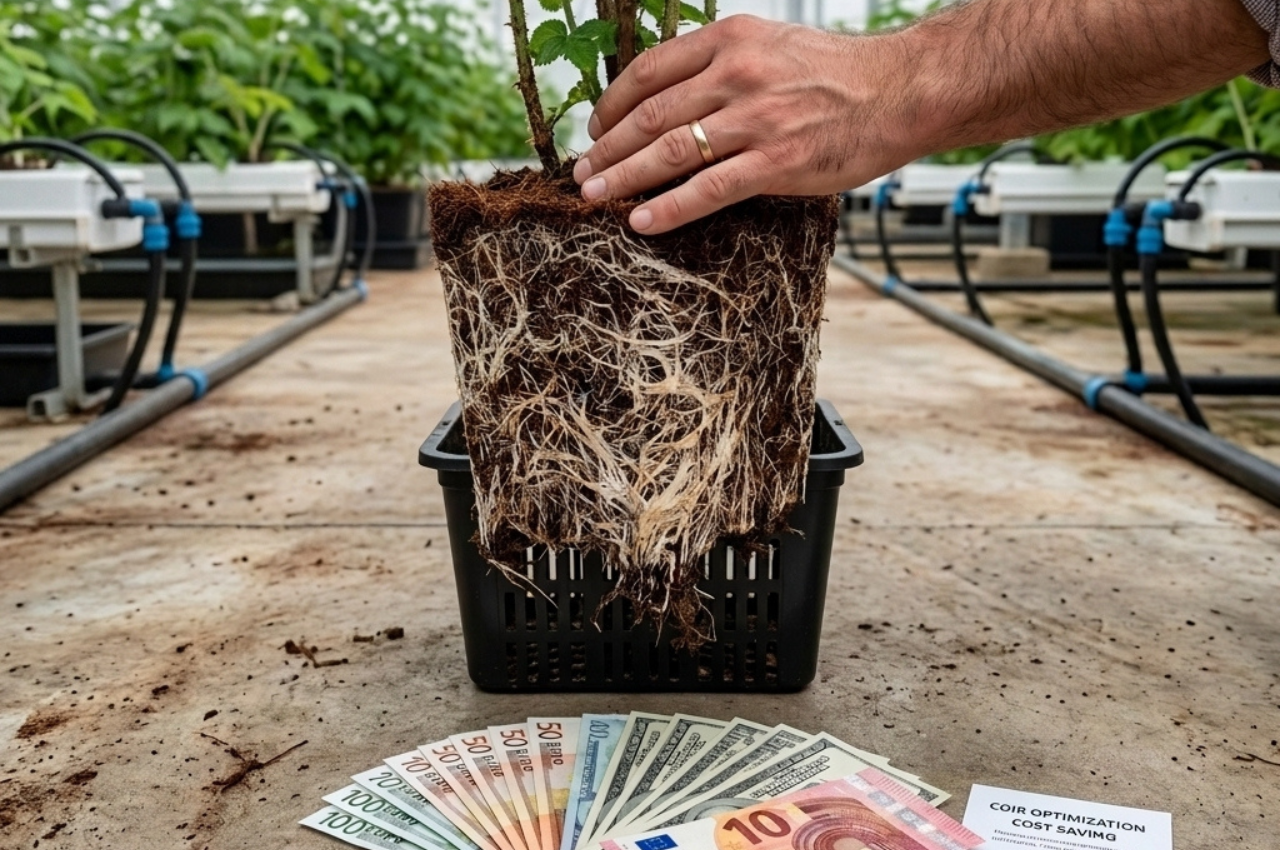
In berry production, substrate rarely gets much respect. It sits at the bottom of the budget conversation, somewhere between spraying and irrigation. And yet, it is the environment where everything either works or doesn’t.
The numbers are not dramatic. In raspberry production, substrate typically represents somewhere between 0.15 and 0.25 €/kg of fruit produced, depending on cycle length, yields per hectare, and what you’re actually counting. That translates to roughly 2.5 to 4.0% of total production cost. A small line. Easy to cut.
And that is exactly why it gets cut first.
Growers know they cannot negotiate labour costs, only efficiency. Plant prices have limited flexibility. Trays, transport, cold chain, these items together account for more than half of total production costs, and there is not much room to move. So when pressure comes, and it always does, the substrate budget is one of the few places that feels negotiable.
The problem is not the instinct to reduce costs. The problem is the sequence.
Before dropping to a lower quality substrate or committing to a recycling programme, there are questions that rarely get asked. Are you buying dehydrated substrate in brick format rather than pre-hydrated big bales or bags, and have you actually compared the landed cost per litre of usable volume? Are you purchasing far enough in advance to access direct container pricing from Sri Lanka or India? Have you requested and reviewed the dust content specification of what you are currently buying? Is the current coir mix, whether pure or blended, actually the best option for your crop and root environment, or is it the one the supplier has been sending for years?
These are not complex questions. They are just not being asked.
Recycling substrate is not wrong. Done properly, it can make sense, both economically and environmentally. The difficulty is that very few operations are doing it properly. Dust accumulation, inadequate sterilisation, no amendment of buffering capacity, no assessment of structure loss. The substrate goes back in the system looking like substrate, but no longer functioning like one.
There is another budget line worth mentioning. Foliar applications and biostimulants. This category tends to escape the same level of scrutiny that substrate receives. Products get added to programmes, sometimes for years, without any serious measurement of return. The substrate budget gets challenged. The biostimulant list grows quietly.
And perhaps the most important question, the one almost nobody answers with real data: are you achieving the same productivity with the cheaper or recycled substrate? If yes, the decision is justified. But in most cases, the honest answer is that nobody measured it properly, and nobody is sure.
Saving 3% while losing 10% in yield is not a saving. It is just harder to see on a spreadsheet.