
In berry production, innovation is everywhere. New apps, AI platforms, oxygen injected into irrigation water, and an endless stream of specialty products promising incremental gains.
None of this is inherently wrong. Technology has an important role in modern horticulture. The problem appears when sophistication advances faster than the fundamentals.
Across many farms and regions, the same pattern keeps emerging. Growers are increasingly willing to invest in tools that optimize the last five percent of performance, while the first eighty percent still depends on systems that are structurally fragile.
Plants, however, remain remarkably conservative.
- They still respond first to genetics and plant quality.
- They still depend on a healthy and well aerated root environment.
- They still require uniform water and nutrient delivery.
- They still react primarily to temperature, radiation and root zone conditions.
No software layer can compensate for weaknesses in these areas.
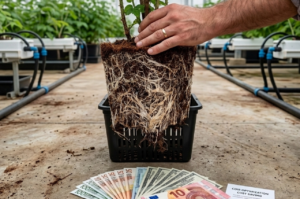
One of the most common examples appears at the root level. In an effort to control upfront costs, substrate quality is often negotiated, beds are kept smaller than optimal, or irrigation is simplified to a single drip line where distribution clearly benefits from two. For a period, the system appears to function. Then variability begins to surface, root development becomes uneven, and plant performance starts to diverge across the field.
At that point, the response is frequently to add more inputs.
- More weekly products.
- More corrective applications.
- More fine tuning.
But in many cases, the plant is not asking for more products. It is asking for a better physical environment.
The same logic applies under high temperature conditions. It is increasingly common to see investment in anti stress products while structural solutions such as shade netting or low pressure sprinkler systems remain absent, even in locations where water availability would allow their use. Trying to solve a physics problem with chemistry rarely delivers consistent results.
Irrigation continues to be one of the most underestimated levers in berry performance. Not only scheduling, but the full capacity of the system to deliver the right volume, with uniform distribution, appropriate nutrient concentration and reliable monitoring. Before machine learning and predictive dashboards, the plant still depends on receiving what it needs, when it needs it, every day of the season.
The same economic pattern appears at field scale. Operations may save on proper land leveling, drainage infrastructure or soil correction, only to face waterlogging, root stress and lost productivity during the first challenging winter. Land that looked inexpensive during acquisition often becomes costly once biological reality takes over.
None of this is an argument against innovation. Advanced tools, sensors and decision support systems can generate real value when they are layered on top of solid agronomic foundations.
But sequence matters.
The most resilient and profitable berry operations tend to follow a quiet discipline. They secure plant quality and genetics first. They build a robust root environment. They invest in climate management and irrigation capacity. They implement basic, reliable sensing. Only then do they move into higher level optimization.
You cannot optimize structural weakness.
In a sector where margins are tight and biology is unforgiving, the most powerful question is often the simplest one.
Before adding the next technology layer, are the basics already working at full capacity?
In many farms, the fastest way forward is still, quietly, back to basics.