Starting with the title, I need to admit something embarrassing. I had never heard about Pierre de Beaumarchais, the 18th-century French writer behind The Barber of Seville, until I stumbled across one of his quotes thanks to John Handford, a British Fruit Advisor and Senior Partner at FAST LLP, and someone I truly respect.
In agriculture, we often act as if his line “too much is never enough” were an operating principle. Especially when it comes to biostimulants. We add them to foliar feeds, irrigation tanks, and spraying programs almost instinctively. But do we really know what we are getting back?
Elon Musk has a simple rule at Tesla: if a part or process is not truly necessary, it should not exist. Shouldn’t agriculture apply the same thinking before adding yet another product to the crop?
The biostimulants market, however, suggests the opposite. According to **Grand View Research (2023)**¹, the global market was valued at around USD 2.6 billion in 2022, with projections of USD 4.6 billion by 2030 at a CAGR of ~7.4%. **Markets and Markets (2024)**² places the figure at USD 4.46 billion by 2025, potentially exceeding USD 7.8 billion by 2030. **Fortune Business Insights (2024)**³ estimates the value already at USD 4.0 billion in 2024, with forecasts close to USD 9.8 billion by 2032. Categories include seaweed extracts, amino acids, humic and fulvic acids, protein hydrolysates, and beneficial microorganisms such as Bacillus and Pseudomonas.
Europe currently leads the market, representing close to 40% of the global share. Latin America shows the fastest growth. In Brazil, for example, bioinputs are expanding at more than 20% per year, which is four times the global average, with sales reaching nearly BRL 5 billion (~USD 1 billion) in 2023/24 (Grand View Research, Latin America Outlook, 2023)⁴.
It sounds impressive, but here is the uncomfortable question. Are all these inputs really delivering measurable value to the crop? Or are we just adding products because they “sound good”? Entrepreneurs like Richard Branson and Steven Bartlett often remind us that simplicity and focus are the real competitive advantages. Agriculture could use a bit more of that thinking.
That said, it is important to recognize the real benefits. Many biostimulants do play a positive role. They can increase plant resilience to stress, strengthen natural defense mechanisms, and in some cases act as true alternatives to fungicides, insecticides or acaricides. These products are not just “extras” in all cases. Some genuinely reduce crop losses and extend the grower’s toolbox at a time when conventional solutions are becoming scarcer and more restricted every year.
The problem is not the concept itself, but the lack of consistent validation. Too often products are applied generously, yet rarely tested with proper controls. Most farmers I know do not allocate a specific budget for these extras. Even fewer leave untreated control areas to compare. The result is that no one really knows which products deliver value, which ones do nothing, and which ones just look good in the sales pitch.
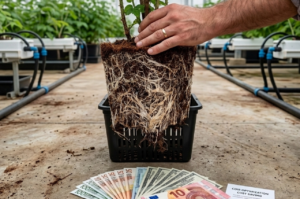
In soft fruit production, I have seen growers spending EUR 2,000 to 5,000 per hectare per year on these extras. But very few can tell me how many additional kilograms of fruit they actually harvested because of them. It is not enough to observe more leaves, roots or greener plants. What matters is whether extra kilograms were sold, whether the revenue covers the cost of the product, the labor to apply it, and the hidden costs behind it. Only then can we calculate the net profit impact.
And that should be the real decision-making loop: apply, test against a control, measure yield in kilograms, calculate net profit, then decide.
Anything else risks proving Beaumarchais right, too much is never enough.
References
- Grand View Research. (2023). Biostimulants Market Size, Share & Growth Report, 2030.
- Markets and Markets. (2024). Biostimulants Market Size, Share, Trends & Forecast, 2030.
- Fortune Business Insights. (2024). Biostimulants Market Size, Share, Growth and Forecast, 2032.
- Grand View Research. (2023). Latin America Biostimulants Market Outlook.